System of a Daun
An independent proof that I can design and deliver complete monitoring systems.
System of a Daun is a plant-intelligence platform built to demonstrate a reusable systems approach in a domain separate from my professional work.
I designed and built the complete platform independently: embedded sensing, Android edge imaging, device provisioning, authenticated ingestion, time-series storage, operational workflows, web interfaces, and deployment infrastructure.
- Role
- Sole designer and engineer
- Scope
- Embedded · Android · Backend · Data · Web · Infrastructure
- Status
- Operational prototype
Why this project exists
Much of the systems work I do professionally is proprietary and cannot be shown publicly. I built System of a Daun to demonstrate that the underlying capability is not tied to one company, one machine type, or one existing product.
The domain is different, but the systems problem is familiar: identify the physical entities, determine what should be observed, define device and data relationships, and build the software required to operate the resulting system.
This project is evidence that I can reproduce that capability independently from first principles.
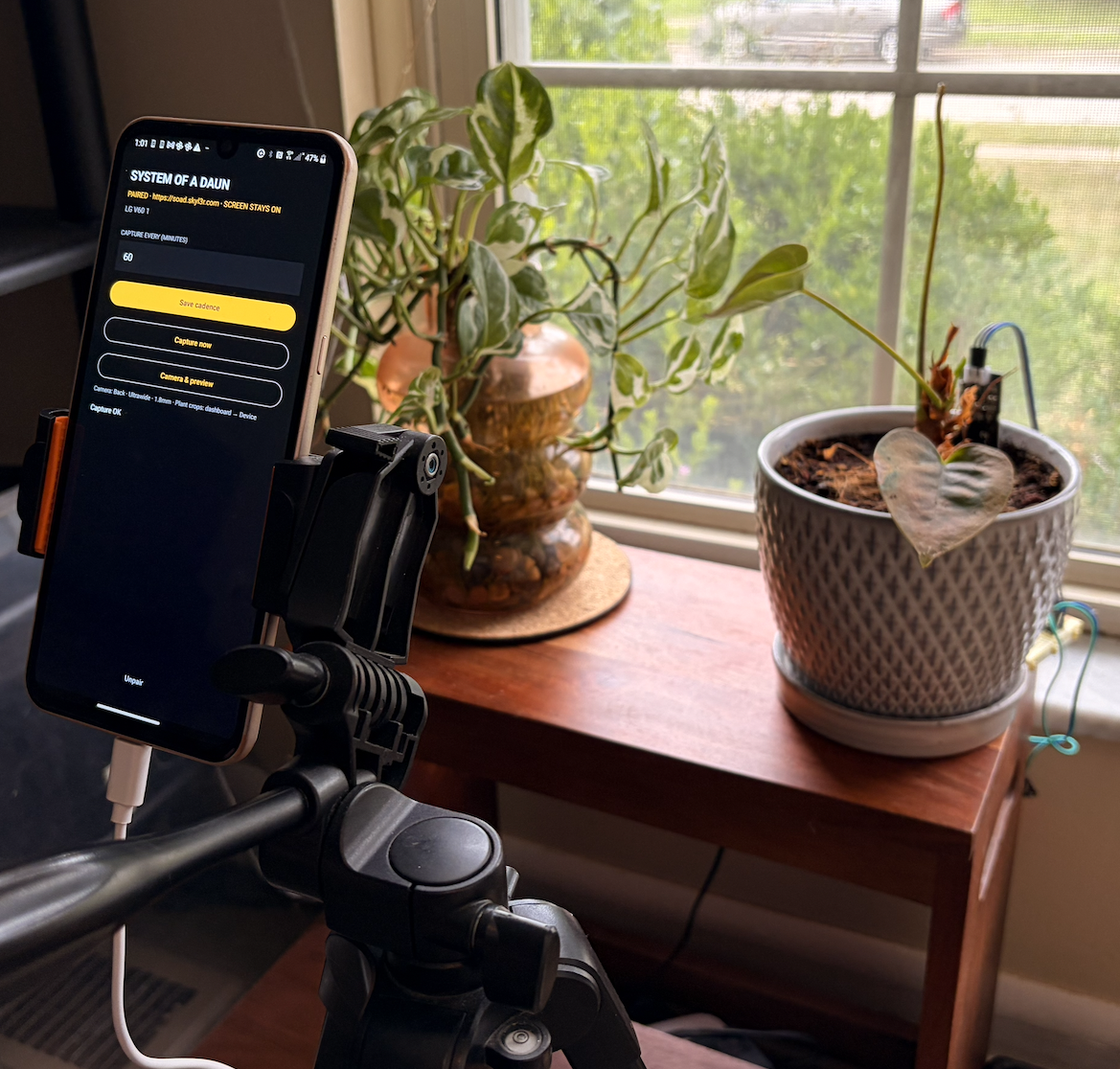
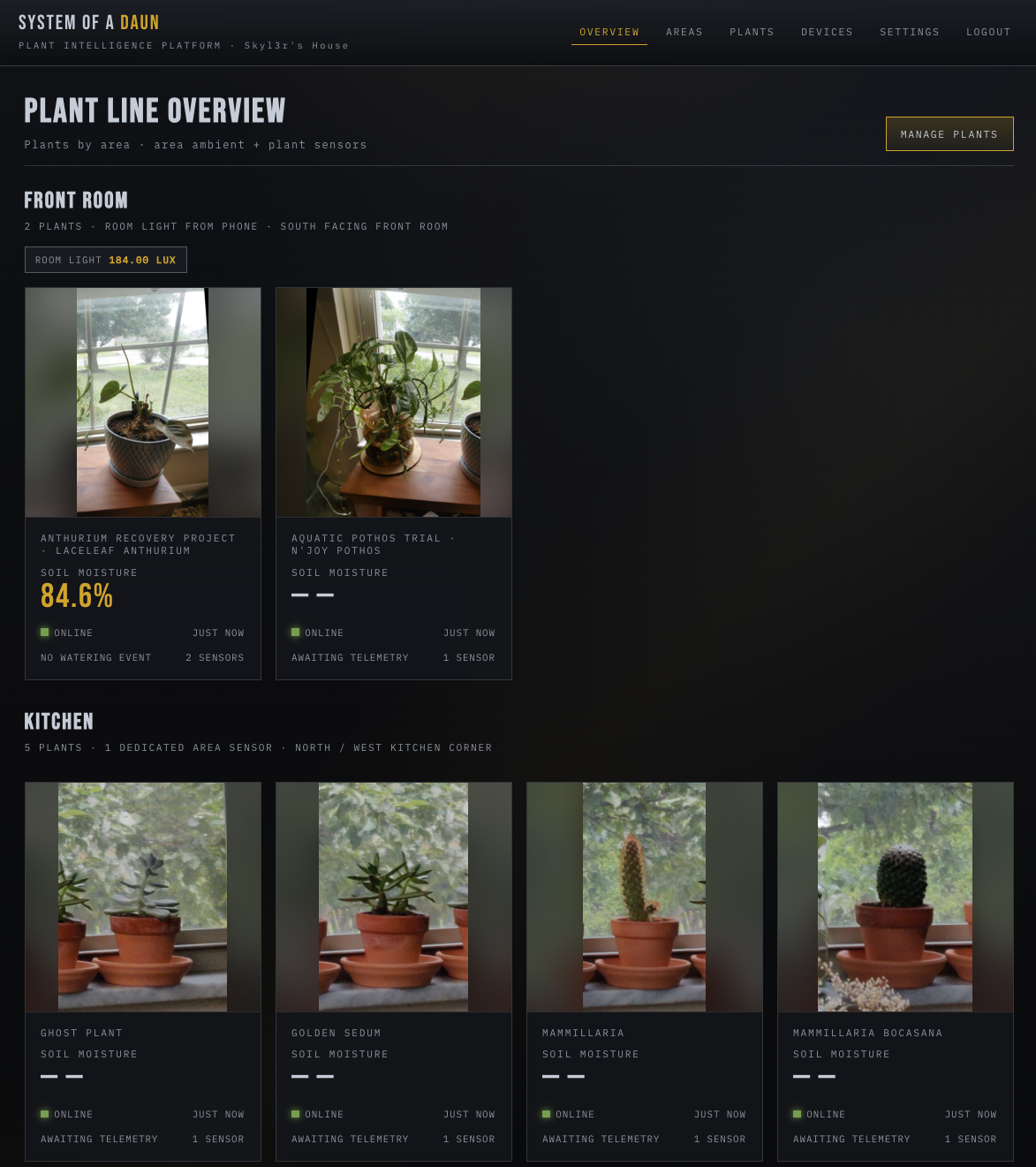
Live plant line
The feed below is pulled live from the production tenant status API.
What I built
Physical observation
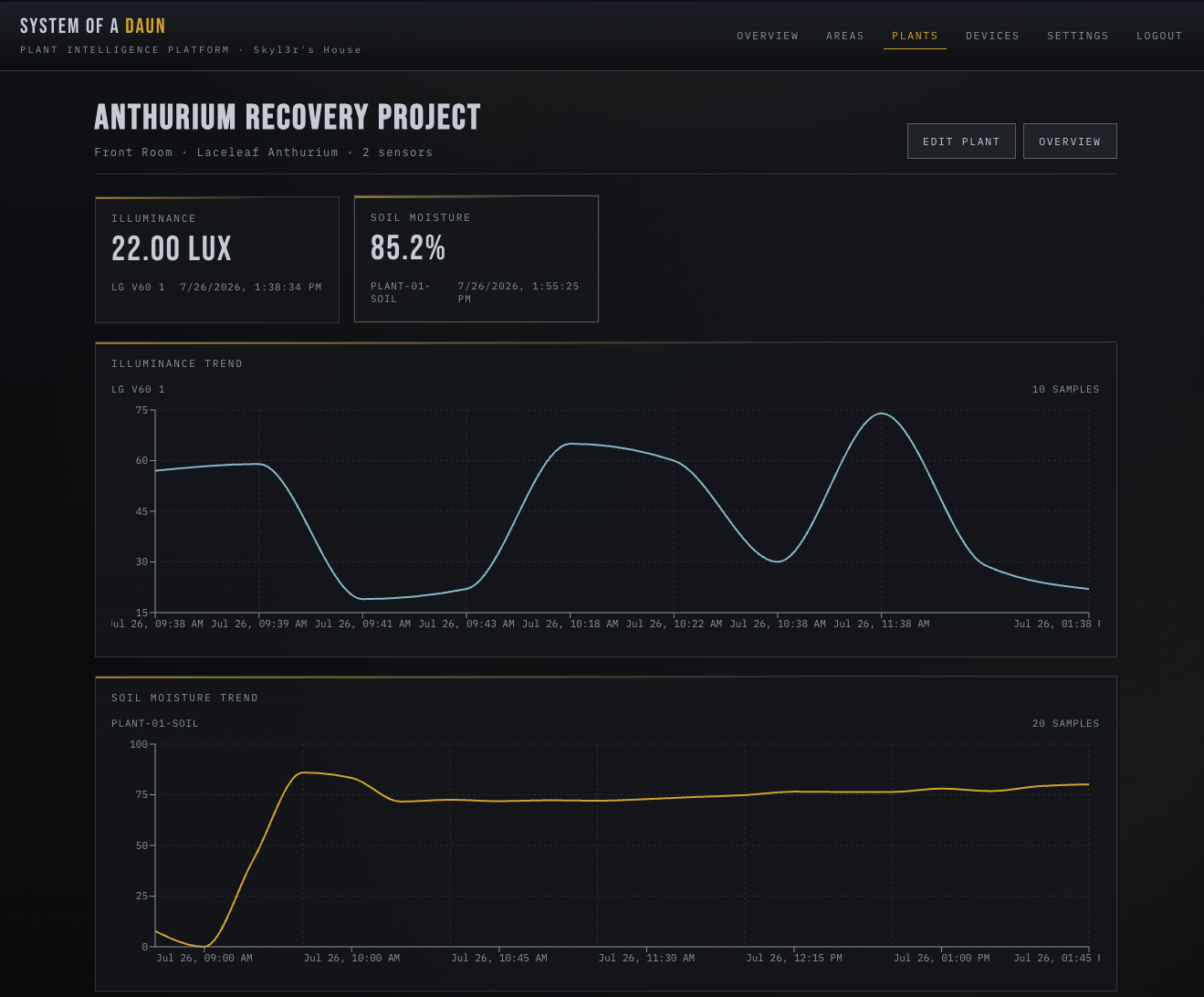
ESP32 probes collect calibrated soil-moisture readings on a fixed sample interval.
Repurposed Android phones act as edge monitoring devices: one-time pairing, scheduled plant photography, optional illuminance readings, heartbeats, and remote capture commands.
Multiple probes and phones can be provisioned and assigned without custom development.
Operational context
The platform models tenants, areas, plants, devices, assignments, observations, images, and assessments.
Devices are managed independently from the plants they monitor, allowing hardware to be replaced, reassigned, or scoped to one or several plants.
The system tracks device contact separately from the latest reading timestamp. The operator UI primarily surfaces freshness as contact-based ONLINE, STALE, or OFFLINE state.
Historical record
Telemetry and image observations are stored over time and presented together at the plant level.
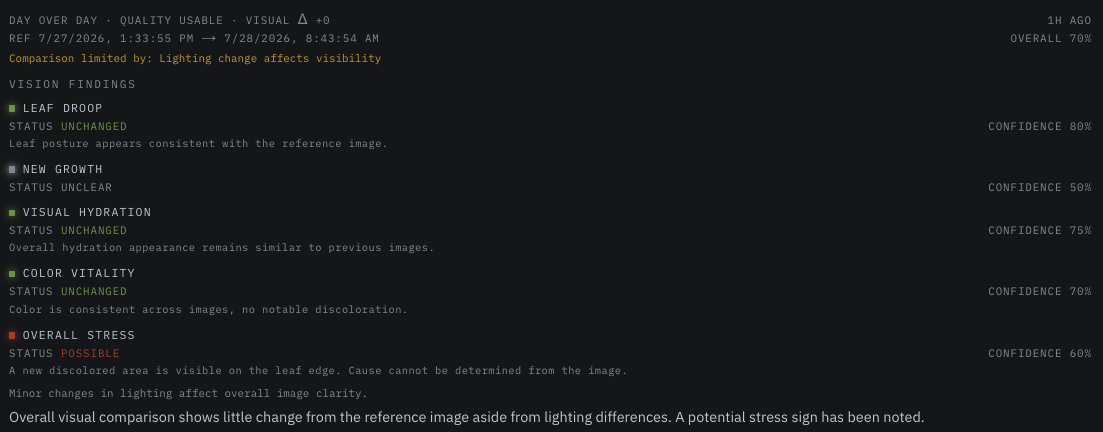
The web application exposes current state, historical trends, photographic history, and scheduled day-over-day or week-over-week comparisons.
Bounded interpretation
Optional visual assessments compare plant images over defined intervals and describe observable changes.
They are framed as observational comparisons rather than diagnoses and are withheld when suitable comparison frames are unavailable.
Turning the physical domain into an operating model
The core task was not collecting a moisture value. It was defining the relationships required to operate a physical monitoring system repeatedly.
Tenant
└── Area
    ├── Plants
    │   ├── Telemetry
    │   ├── Photo frames
    │   ├── Assessments
    │   └── Device assignments
    └── Devices
        ├── Probe
        ├── Phone monitor
        └── Area sensor
A plant is the monitored asset, but it does not own its hardware.
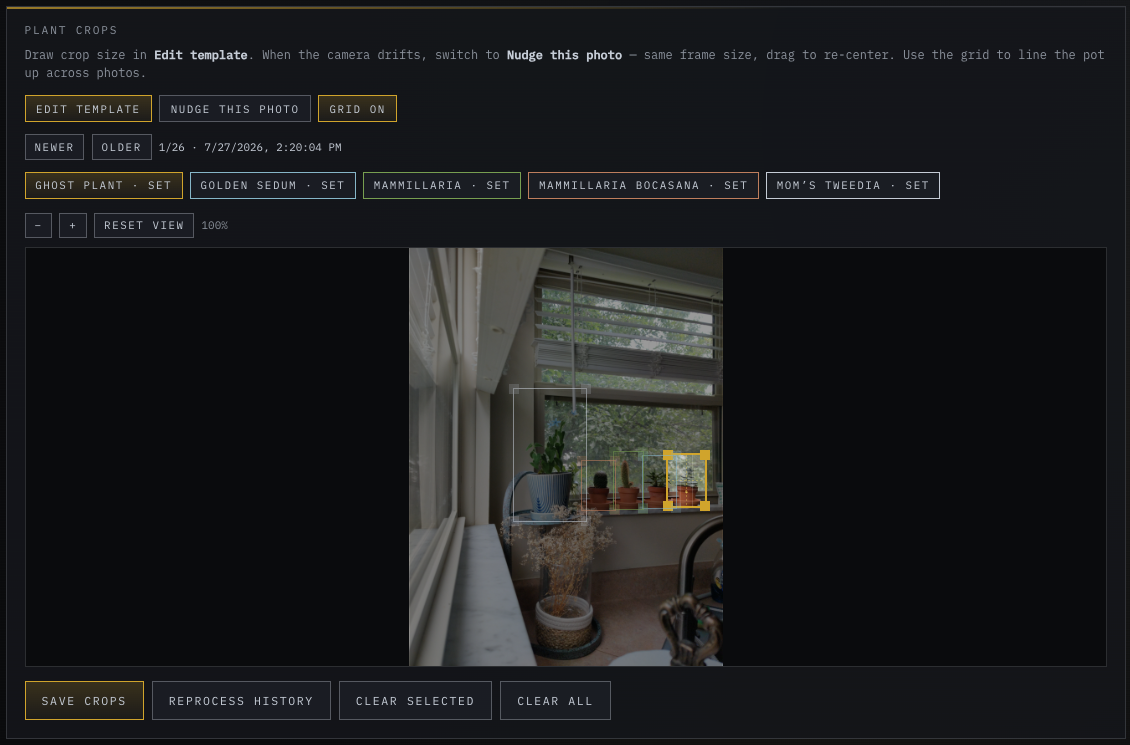
Devices are provisioned independently and assigned by scope. A probe may monitor one or several plants. A phone may capture several plants in an area. An area sensor may provide context without belonging to a specific plant.
This separation keeps device lifecycle, asset lifecycle, and observation history distinct.
The complete operating loop
ESP32 probe
- 1.authenticated telemetry
- 2.validation and tenant resolution
- 3.time-series storage
- 4.current state and historical trends
Android monitor
- 1.scheduled image and light capture
- 2.authenticated upload
- 3.media processing on the platform
- 4.photo history and visual comparison
Web application
- 1.device provisioning and plant assignment
- 2.plant and area management
- 3.telemetry, image, and assessment workflows
Each device authenticates using a provisioned credential. Tenant ownership and scope are derived from that credential rather than trusted from client-submitted identifiers.
Numeric observations use a flexible metric model, allowing additional sensor types to enter the same ingestion path without requiring a new storage schema for every metric.
Designed for physical-system behavior
Intermittent connectivity
Devices report last contact (last_seen_at) separately from the latest reading timestamp. In the shipping UI, freshness is mainly expressed as contact-based ONLINE, STALE, or OFFLINE labels.
Independent lifecycles
Plants, probes, and phones are separate managed entities. Hardware can be replaced or reassigned without destroying the monitored asset’s history.
Repeatable provisioning
Phones pair through temporary codes. Probes receive scoped credentials. Devices are assigned through the web application rather than hard-coded to a single deployment.
Variable visual evidence
Image comparisons operate across changing light, framing, obstruction, and plant movement. Assessments remain observational and may decline to produce a result when the evidence is insufficient.
What this project demonstrates
System of a Daun was not primarily a learning exercise. It was an independent proof of execution.
I selected a domain unrelated to the proprietary systems I work on professionally and applied the same broad capability: define the domain, design the operating model, connect physical devices to software, and deliver the complete system as a coherent product.
- End-to-end ownership across firmware, Android, backend, data, web, and deployment
- A reusable provisioning and device-assignment model
- A unified history of telemetry, imagery, device state, and assessments
- Operational handling for stale, missing, and uninitialized data
- A system that can accept multiple devices and monitored assets without bespoke development
- Product and interface decisions grounded in how the physical system is operated
Guided views
System architecture
Edge sensing
ESP32 DevKit V1 with a capacitive soil-moisture sensor, calibration support, fixed-interval scheduled readings, and provisioned device credentials.
Edge imaging
Native Android application for one-time pairing, scheduled photography, optional illuminance capture, heartbeat reporting, and remote preview/capture commands. Plant and crop assignment is handled in the dashboard.
Platform services
FastAPI, Alembic, and TimescaleDB for authenticated ingestion, tenant isolation, device management, time-series observations, media metadata, and assessment scheduling.
Operator application
Next.js interface for areas, plants, devices, historical telemetry, image frames, assessments, and configuration.
Deployment
Docker Compose and nginx.
Stack: ESP32 / PlatformIO · Android · FastAPI · Alembic · TimescaleDB · Next.js · Docker Compose · nginx
The implementation is maintained privately. This case study focuses on system design, operating behavior, and complete execution.